

A few weeks back, I was fortunate to get my first opportunity to try Computer Junkyard from Dream Egg Games — it’s one of those titles I’d had sitting on the shelf for a few months. Unfortunately, our first play didn’t quite go as well as I’d hoped, but don’t despair just yet because ‘tis merely a bug perhaps…
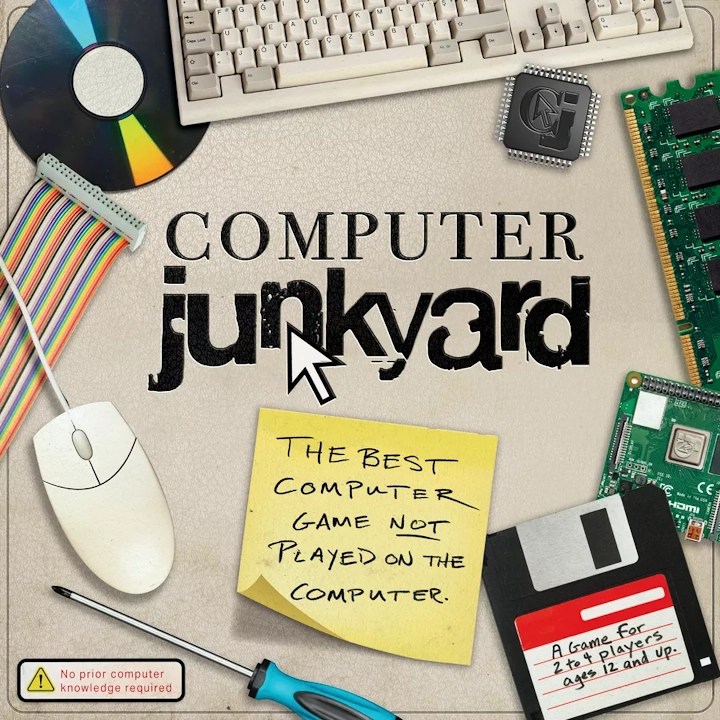
Designed by Allan and Jared Pincus, I was originally drawn towards it partially because of the Tetris-like gameplay that has you buying and placing tiles onto a ‘chassis board’ —this had me thinking of Art Society (2023), a game I do really like— but also because the theme appeals to the computer geek in me. As one of those little boomers that knew more about computers than most of my school teachers back in the 1980s, Computer Junkyard pushes a lot of the right buttons, so to speak — and yes, I can and do always build and upgrade my own computers when I need to!
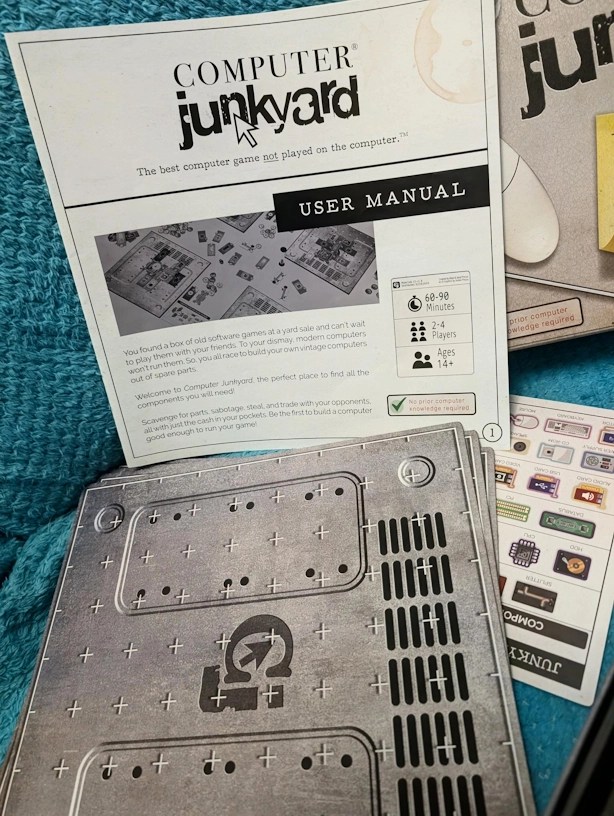
I should also give full credit to the designer of the rulebook which is styled to be particularly reminiscent of the old computer manuals of the time —complete with pre-marked tea-stain for the true PC afficionados! A nice extra touch was including an ‘Anatomy of a Computer’ section at the back which explains a lot of the bits’n’bobs required to build your own, thus giving credence to what the game is all about.
What are we doing?
The basic idea behind the game is that players need to build a custom computer —we’ll call it a PC hereafter— so they can run old software (games) on it, although technically you’re all aiming to run just one particular PC game that you’ve found. Each player will have a different game to run, each with unique build requirements like extra hard disks, extra memory (RAM), and/or additional CPUs, etc.
Before you can get anywhere near that custom PC build, however, you’ll need to have the fundamentals of an old PC sorted, which will include more basic requirements like a motherboard, CPU, power supply, video and audio card, a monitor, etc. (see photo below).

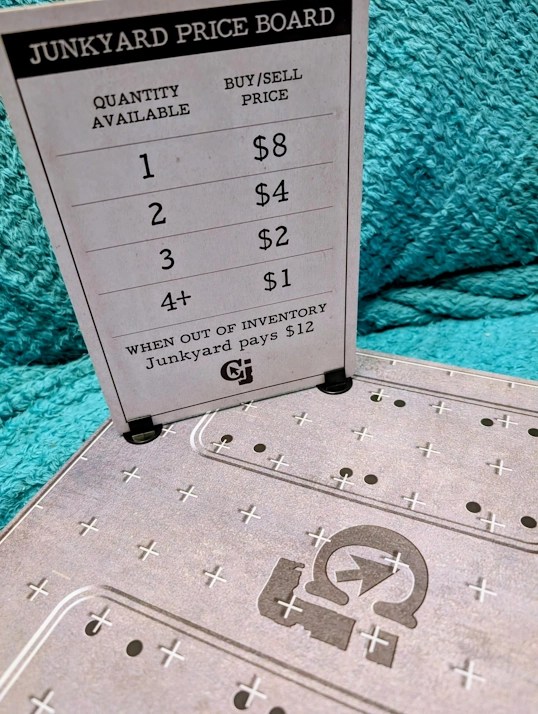
There are a lot of bits in the box, but it’s mainly cardboard tiles representing different parts of a PC (helpfully colour-coded), as well as a junkyard price board, coins, a single 10-sided die, a 2-minute sand timer, and a few extra bits (computer locks and bug sprays, oh my…)
Rounds are split into a Pre-Build phase, a Building phase, and a System Check phase, and players use the Pre-Build to draw a couple of tiles from a bag to add to the junkyard before deciding whether to visit the junkyard (to buy / sell parts), debug their PC if it’s been bugged (usu. by another player), make or break any deals with other players, or steal a tile from someone else.
The second phase is where the sand timer comes in, because it’s here that players will get 2 minutes to build and tinker with their PC build, swapping and changing bits as they see fit, connecting tiles together (provided they’re not bugged or otherwise locked in place), etc. This is arguably supposed to be where the ‘meat’ of the game is, but it’s also the phase that gave us the most frustration, especially if you didn’t have the correct part to help connect things together (more of which shortly).
Finally, the last System Check phase is really just to see if any players have built their PC and all the extra bits required to run the software title they were given at the start, thus potentially ending the game (provided they haven’t fallen foul of the PC-building rules).
How did we get on?
Well, this is probably where we had a few hiccups that were not conducive to an immediate replay, at least not without tinkering with some rules first, because we all had a struggle of sorts…
All players start with a basic motherboard tile (which is where every PC build has to start, right?) and 3 other random tiles pulled from the bag. These tiles could literally be any other part of the PC, but thankfully any duplicates upon set-up are immediately replaced, which at least gives players a starting hand of 3 different tiles. There are also a number of tiles already in the junkyard (market) when setting the game up (which can also be anything including duplicates) — and duplicates are actually very welcome here because they will help drive the price down for everybody else.
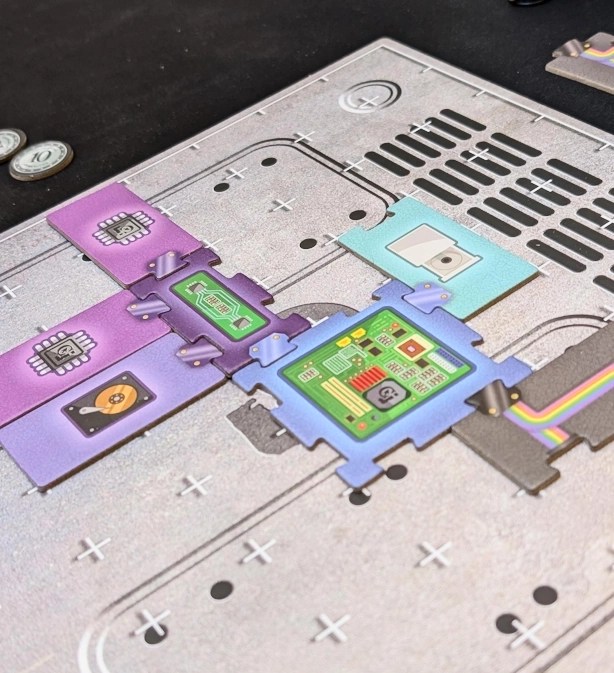
Unfortunately, one of the very key parts that you do also need for your build is a PCI tile (Peripheral Component Interconnect) which helps you connect several things to the main motherboard like a video, audio and USB card. Annoyingly, when no-one around the table had drawn any PCI tiles (and none came out for a good while), we pretty much ran into a black hole very quickly, with twiddling thumbs and nothing to build during phase 2 (that’s the 2-minute Building phase I mentioned)…
We actually just skipped the Building phase altogether after that, because no-one had anywhere to go until the first PCI tile appeared, so it seemed more fun just to try and pinch things from each other — which is what that 10-sided die is for, btw!
Anyway, as it happens, a couple of PCI tiles did eventually come out for the junkyard at once, immediately giving that player a chance to snap both of them up and deny everyone else an opportunity to get going! He sold one of them to one of the other players, and at that point they could both get on with their own builds, leaving the other two players (including me) still twiddling our thumbs — and spitting (just a bit) at this point!
Frustration took hold for a few more rounds, but we did eventually each get a PCI tile (at exorbitant expense for one player) but at this point most players had also ran out of money, which put another spanner in the works… Arrrggghhh!
I will say that those players that got the PCI tile(s) first didn’t actually win, but that’s a moot point just now…
Did it all work out in the end?
I’m not going to lie, our first go at Computer Junkyard wasn’t a particularly great experience: the game dragged a lot, especially early on when nobody had a PCI tile; then it dragged again when players ran out of money and were just trying to utilise shrewd junkyard sales to try to get the bits they wanted, etc. And ultimately, this delivered a rather frustrating 80-minutes or so (with four players), although I do actually have a potential solution which I think will help considerably next time…

The two key things we struggled with were the lack of PCI tiles, and a lack of money, although ironically the rules have an easier variant whereby players can optionally choose to just collect $4 during the Pre-Build phase instead of buying / selling anything (which would’ve neatly solved the money issue we ran into).
You could also argue that the lack of PCI tiles was just a one-off and maybe just a bit unlucky, but because it so fundamentally broke the game for us (especially because we literally couldn’t do anything during the Building phase), I honestly think players should just start with one random PCI tile at the beginning of the game —alongside their motherboard— and then maybe draw just 2 tiles from the bag at the start (instead of 3). Besides anything else, this will likely chop at least 20-30 minutes off the running time, which is honestly no bad thing in my book.
To summarise, I do believe Computer Junkyard has a good game at its heart, but we shouldn’t have had to work so hard to find it, and I think the two simple rule changes I’ve outlined above would make the whole game significantly easier, as well as more palatable for all concerned…
— Alex Bardy, 23Oct26
