

I got the opportunity to play my first games of The Dealer (2026) and Ink (2025) at the weekend, and enjoyed both. Here’s how things went…
The Dealer (2026)
I briefly covered this last month in another TSM Blog —New Arrivals… Tulip Season (2026) and The Dealer (2026)— and at the time suggested that it looked very promising, so I’m very pleased to say that it proved a lot more than just promising when we finally got an opportunity to play it… And the artwork remains just another positive for the game as a whole.
We played a 6-player game of this (which basically means 6 rounds), with each person getting the chance to be The Dealer once only — it’s The Dealer’s job to get everyone else to ‘bust’, while every other player will take on a character role that will give them a unique in-game ability for that round… The Dealer role always moves clockwise, while the rest of the roles are randomly assigned to players from a pool of nine.
Designed as a push-your-luck style game, in The Dealer players are initially dealt a single character role (The Gambler, The Giant, The Destroyer, The Sniper, etc) and then dealt cards which everyone else around the table can see but they themselves can not — these cards will always be valued between 0 and 3, and the idea is to try and get a final hand value of 3 to 5 by the end of the round, anything else is considered a ‘bust’ (unless you’re The Giant, in which case you’re allowed a final hand value between 3 and 7). The score in your hand is generally the points you will score, but there are potential bonuses to be had depending entirely on what role you’ve had during the round.
An excellent aspect of the game is in how the individual roles all have special abilities which will allow players to bend the rules slightly…

The Prophet, for example, can guess every card they’re dealt (and have to be told the truth by The Dealer); The Supercomputer will get told if the card they’ve just been dealt is odd or even; The Secret-Keeper will actually get an extra card and be the only one who knows what value that card is, etc.
Similarly, some roles will provide individual advantages that can score more point cards for players at the end of a round (literally just drawn directly from the deck), depending on whether the player busted —scored a hand value outside that 3-5 scoring range— or succeeded. It’s The Dealer’s job to try and get everyone to bust, but arguably it’s everyone’s job to try and bust everyone else as well, because the only points that count are those you score for yourself, no matter how you got there!
The brilliant part happens once all players have received their cards each round, because then everyone gets 30 seconds to do pretty much whatever they want to try and discover what kind of hand they have, before declaring whether or not they’re going to take another card. This was always the best part: a 30-second discussion involving the whole table (and often those not even at the table!) where the interaction is non-stop while players lie, kid, joke, and usually try to confuse everyone else — you’re allowed to tell the truth as well, of course, but where’s the fun in that!?

I will say that a timer would have been very useful, because discussions often went on well beyond the 30-second mark and several times The Dealer had to bring a bit of order back to the table, but with interaction so high (and happening every round any player continues to take on more cards), everyone was engaged throughout, and you’ll always get some players that swear they’re telling the truth while others are just lying their socks off. The confusion and uncertainty this sowed at the table was remarkable and evidently proved key to the fun of the game.
Needless to say, the table got loud several times and attracted additional attention a bit too often, mainly because the only rule for those 30 seconds is that you cannot look directly at your own hand of cards. That obviously doesn’t preclude you, however, from asking a complete stranger walking past the table to tell you what your card is while the rest of the table frantically explain why they shouldn’t do that!
The Dealer may have a very simple premise but nonetheless proved an excellent and engaging experience for all players. The entire 6-player game took about 35-40 minutes, gave us plenty of laughs, and was both hugely enjoyable and very engaging throughout. I’m looking forward to the next time I can introduce this to more players, but it’s well worth the current asking price, I think…
Ink (2025)
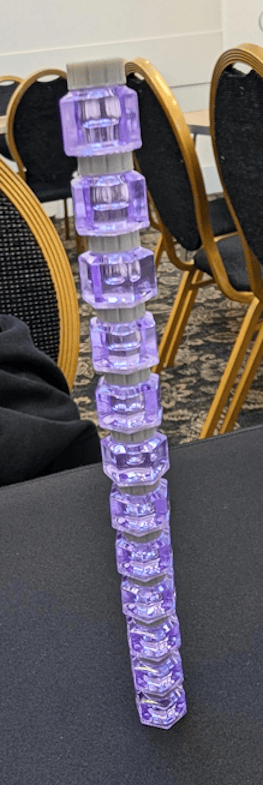
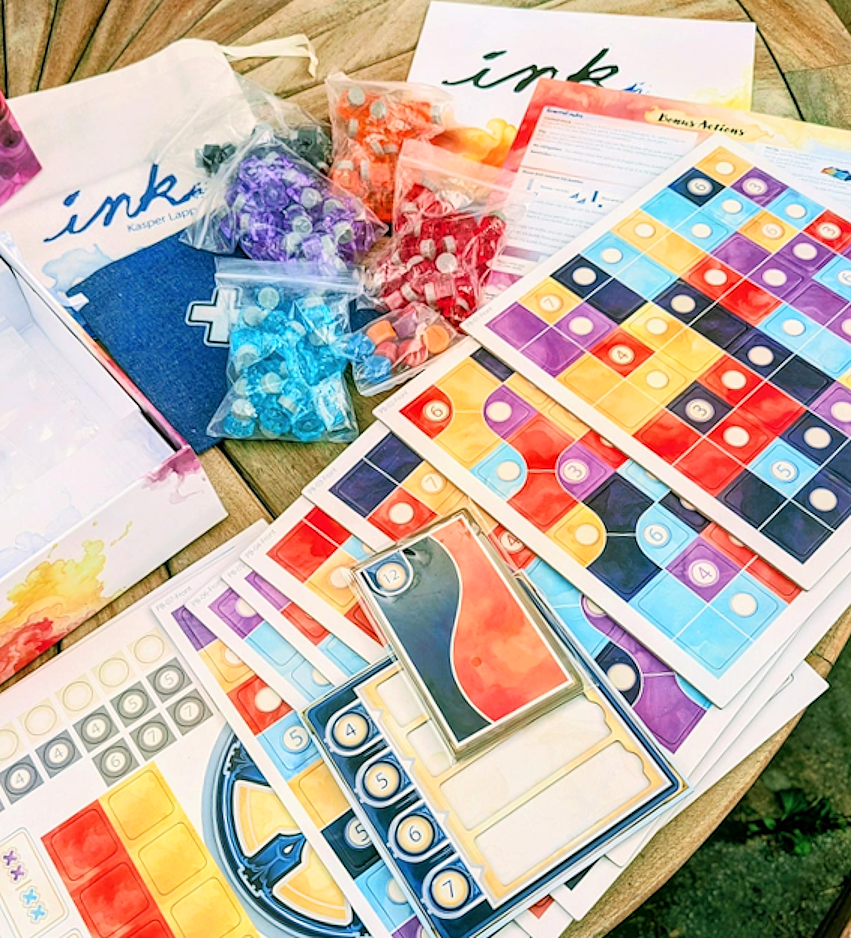
This is another one of those games I’m hoping to write an Unboxing… post on some time soon, but I confess it’s been sitting on the shelf for several months having been purchased on a whim earlier this year. I bought it mainly because I just loved all those very pretty colourful inkpot pieces —I know, go ahead and judge me— but also the basic idea behind the game quite appealed to me. The gameplay of Ink feels a lot like Nova Luna (in which you’re building a tableau whilst trying to get rid of all your pieces before everyone else), and since that’s a game that has always been enjoyed by my regular gaming group, I figured this would probably be well received by the same crowd…

As it happens, I ended up playing this with a random group of other players at Beyond Monopoly! in York, and as a 4-player game it worked very well — and took probably just shy of an hour or so. The objective? Get rid of your 24 inkpots before everyone else by laying tiles into a tableau and working towards the target numbers shown on them. 12 of your inkpots are considered generic and can go on any colour palette tile, but the other 12 have to be played on one of just two colours — those shown on your starting palette card. Of course, there are several other things that will complicate matters, but that’s the main concept of the game, and with a similar mechanism to Nova Luna at its core (going around a central board and picking up a tile each turn to add to your personal tableau) you can see where the obvious comparison gets an invite.
Putting together the right kind of tableau is key here as you work towards set objectives that involve stringing the same colour tiles together (which in turn grant additional abilities). I actually thought I was doing very well initially because I’d managed to place plenty of my inkpots down before other players seemed to even get off the starting block, but as I predicted at the time, I was waiting for the inevitable ‘crunch’ to appear —you know, that mythical wall you’ll hit mid-game where you’ll suddenly realise there’s a practical problem to overcome— and sure enough appear it did, because after the initial flurry I really did struggle to get my more discerning coloured bottles in play after that… There is a way of shifting a couple of ink bottles from one pool to the next, but this effectively involves skipping a tile pick and missing a turn, which is generally not a great idea if you can help it!
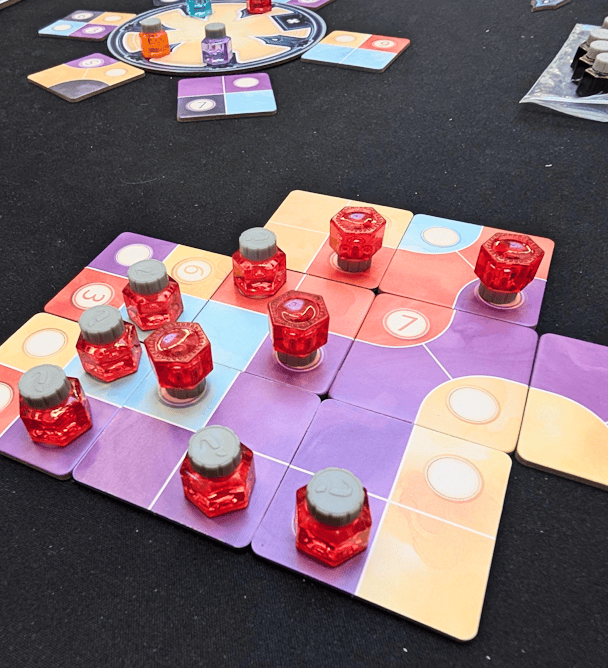
All told, it proved an interesting game, a rather entertaining strategic puzzle, and there were definitely a few of those all-important moments in the game when you just had to sit back and admire another player string together multiple turns and lay down a swathe of ink bottles all in one go —something that had clearly taken a bit of preparation— bravo and well played to them, I say!
Having finally got it to the table (and enjoyed it), I’m pretty sure Ink will be an easy one to introduce to more people (including my own gaming groups), and might yet even replace Nova Luna in that transient, nebulous hierarchy of gaming choices we all have to make on selected boardgaming nights… 🧐
— Alex Bardy, 06Oct26
