

I wrote a little about Brushwood in another TSM Blog post (August Update… Beyond Monopoly! in York), and having now had the chance to play this several times since, I’m very pleased to say that I rather like it…
As my preferred tastes in boardgaming gradually shift closer and closer towards ‘simple to teach, easy to play’ I can’t help feeling this typifies that in a nutshell, and the fact it rarely takes more than 25-30 minutes to complete a full game makes it especially easy to get to the table.
How does it play?
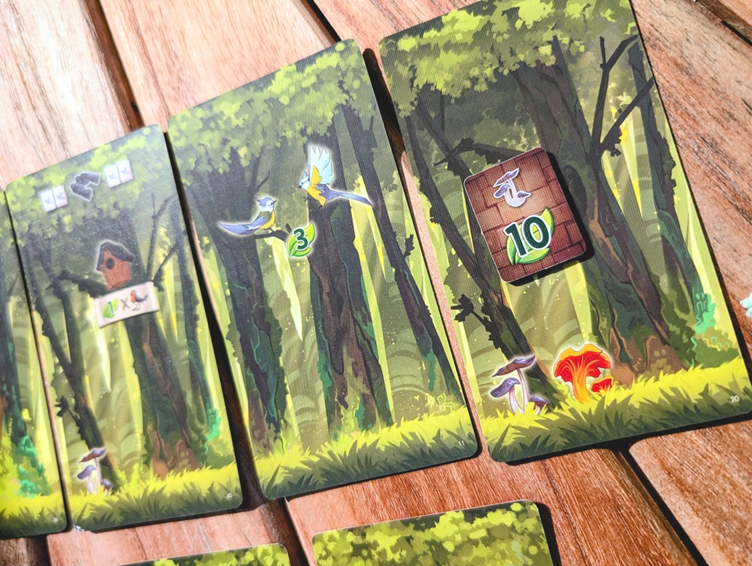
Designed by Filippo Landini for 2-4 players and published by Korea Boardgames, in Brushwood players take on the role of hikers setting off for a gentle woodland walk, and on their travels will collect cards depicting wildlife animals, birds, different types of mushrooms and… erm… birdhouses and binoculars!?


These cards will form a linear tableau in front of each player — or in the case of collecting berries, may have physical berry tokens on them. Animals and birds will score points at the end of the game, but mushrooms have to be collected and claimed mid-game, whilst birdhouses and binoculars will generally score according to how many birds you have in your completed tableau (and where they are positioned in the case of binocular cards). Like everything else, berry tokens are scored at the end as well, based on which players have the most, second-most, etc.
There are seemingly three types of everything in this game: berries, animals, birds (and birdboxes!), and mushrooms. There is also a sub-game of sorts in mushroom collecting: namely, a selection of scoring tokens in the centre of the board which players can only claim when and if they have picked up enough mushrooms (and a relevant mushroom card in their turn). There’s a sub-element of push-your-luck here, because there are more points available for collecting more mushrooms, but once you’ve claimed a scoring token your collection is effectively starting again (but no-one else can collect that token of course), so do you push on and hope to reach those higher mushroom counts, or cut your losses and grab what you can as you go before other players nab them…?


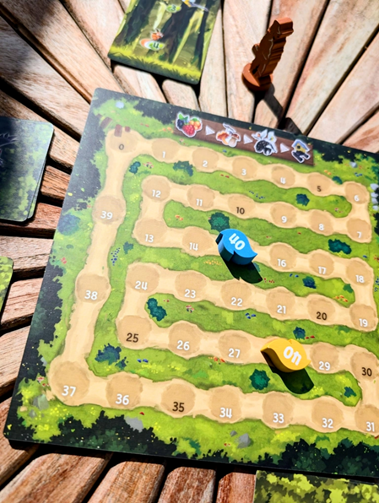
The footprint of the core board is relatively small – a square board with 8 stacks of cards around it (two on each side), and turns are as simple as moving a shared hiker meeple 1-3 spaces around the board and collecting the relevant card at that location to add to your tableau. If you move the hiker more than one space to collect a card, you must place a berry token on the card(s) you’ve just skipped (these are randomly picked out of a small bag), which is where the other sub-game of collecting berries comes into play.


Alas, the linear tableau each player builds in front of them to represent their walk does sprawl out (at least 10-12 cards generally) and this can swallow up that table space very quickly — indeed, this has often led to us having to start another row of cards beneath the first to carry on our trail, but that’s a minor niggle in the grand scheme of things.
The game ends when there are at least 2 spaces / stacks around the board that have no cards on them, at which point final scores are tallied (using the flip side of the board incidentally, which is rather neat).
In summary?
Brushwood plays very quickly, is easy to explain in just a few minutes, and once play begins there’s little down-time — all of these are positives, and I’m struggling to find any negatives to be honest. Some people might consider this a particularly ‘cosy’ or light game (which is no bad thing, either), but there are still plenty of decisions to be made every turn, with several things to focus on.
If anything, I would’ve probably liked to see a bit more variability in what could be collected, but there’s already enough here to make every game feel slightly different. Whether there’s additional longevity after the first ten games or so, I’m perhaps not so sure, but I honestly wouldn’t hesitate to break this out for a quick gaming session if time is short, and I’ve yet to play it with anyone that hasn’t enjoyed the simplicity and speedy gameplay.

— Alex Bardy, 21Sept26
