
The Hobbit: There & Back Again from Office Dog is a game I’ve had on the back burner for quite a while — it’s designed by Reiner Knizia and I’d played it a few times before, but we’d only really explored the first two scenarios —there are eight in total— before it quickly got pushed aside to make way for various other games and titles… No doubt a familiar story for anyone who likes to explore new games and has little self-control — yeh, we’ve all been there, I’m sure!
I actually bought this on a whim a fair while ago, mainly because I was attracted by the theme and it was relatively cheap (about £30 now). Sold as a boxed game and designed for 1-4 players, there is a primitive solo mode also included (designed by Marceline Leiman and Knizia, apparently), but the game is really a glorified roll’n’write — you get 4 lovely hardback books and dry-erase markers included, as well as a selection of tokens (bread, swords, and… erm… pinecones?), a 12-sided black die, and 5 custom white dice.

The custom dice have a selection of symbols and path shapes on them, and these generally dictate what players can do on each turn: they’re drafted by players as you go around the table, and with 2-4 players it means some players will get more dice than others each turn, but since the start player moves on it should even itself out. Some will probably argue there’s always an advantage for the first player but if you play enough turns such that each player gets to be first an equal number of times, I’m sure that would prove acceptable to everyone else around the table.
Anyway, there are eight scenarios here (listed as parts 1-8 and called Adventures in the rulebook) and they’re all played on a different board and with different specialist rules in play. The variety is actually very good, and as sad as it might be to admit, I chose to play through each scenario several times t’other day — primarily to learn how the mechanics of each one worked, but also because I became increasingly frustrated with playing them using the restrictive solo rules (and my scores were pretty shite most of the time). Having played the first three scenarios a couple of times each, I opted to play the rest through to the end just to see how long they took — most of them were done and dusted within 20-25 minutes, and while I didn’t really get on with the weird scoring used for Part 5: Out of the Frying-Pan into the Fire I did nonetheless have some favourites…
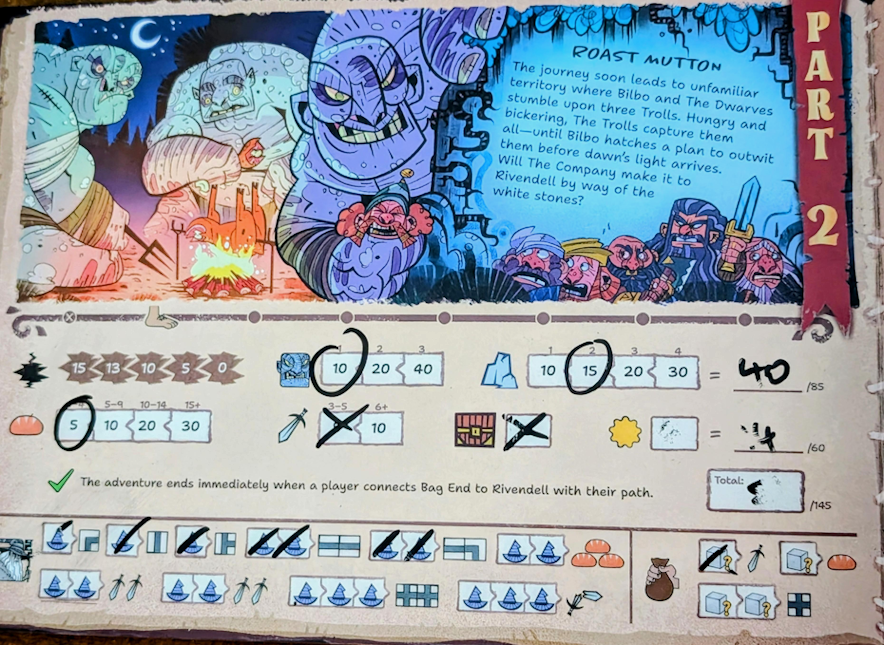
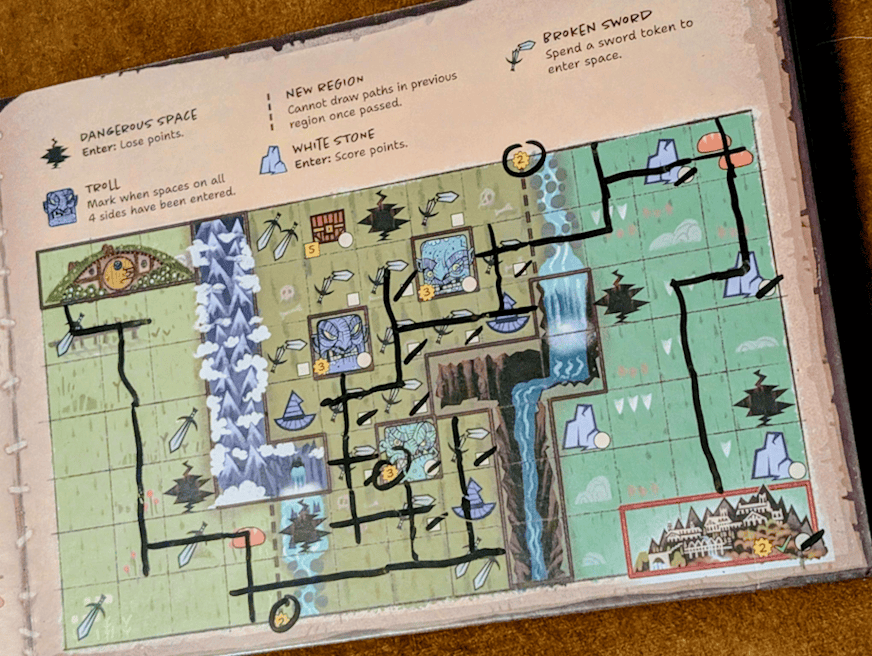

All the scenarios had something or other going for them (yeh, even part 5), but my favourites were parts 4 and 6, and probably 7 and 8 as well. The last two had additional math and underlying stuff going on, while the former used a starkly different style of mechanics (and only the black die) which I particularly liked…
Let me focus on the good stuff, though… Part 4: Riddles in the Dark and Part 6: A Dark Way Through Mirkwood only required the black 12-sided die to play, using a simple shape mechanic that meant the die roll dictated what shape(s) you could draw on the map each turn, the objective being to ‘answer the riddles’ or ‘save the dwarves’ respectively (by surrounding the orthogonally adjacent boxes to those spaces). There were also a selection of squares that allowed additional shapes to be drawn on the board if you filled them in, and this worked particularly well in my opinion. Regardless, I really did enjoy this beautifully simple yet elegant mechanic, and would dearly like to have seen more scenarios adopting it. Whatever the reason, I played these particular games multiple times and found them strangely relaxing compared to the others, almost mellow — that doesn’t necessarily mean they were easier, but in retrospect they definitely required slightly less thinking time, which made the scenarios whip along… 😏

In comparison, Part 7: On the Doorstep and Part 8: Fire and Water were also really good, albeit they used a nice combination of previous mechanics as well as having an additional sub-game of sorts going on. The latter depicted Smaug attacking the houses in Lake-town and felt particularly thematic, which is something I cannot necessarily say for all the rest, as enjoyable as they were.
Overall, ’twas definitely time well spent because next time I get the opportunity to play games in a social setting, this will definitely be worth suggesting… 🤞
I’m not sure if there are long-term plans for future adventures in this series (perhaps covering The Lord of the Rings?), but I do think plenty of other roll’n’write games could learn a trick or two from this selection. Very enjoyable, and easy to recommend.
— Alex Bardy, 10Sept26
